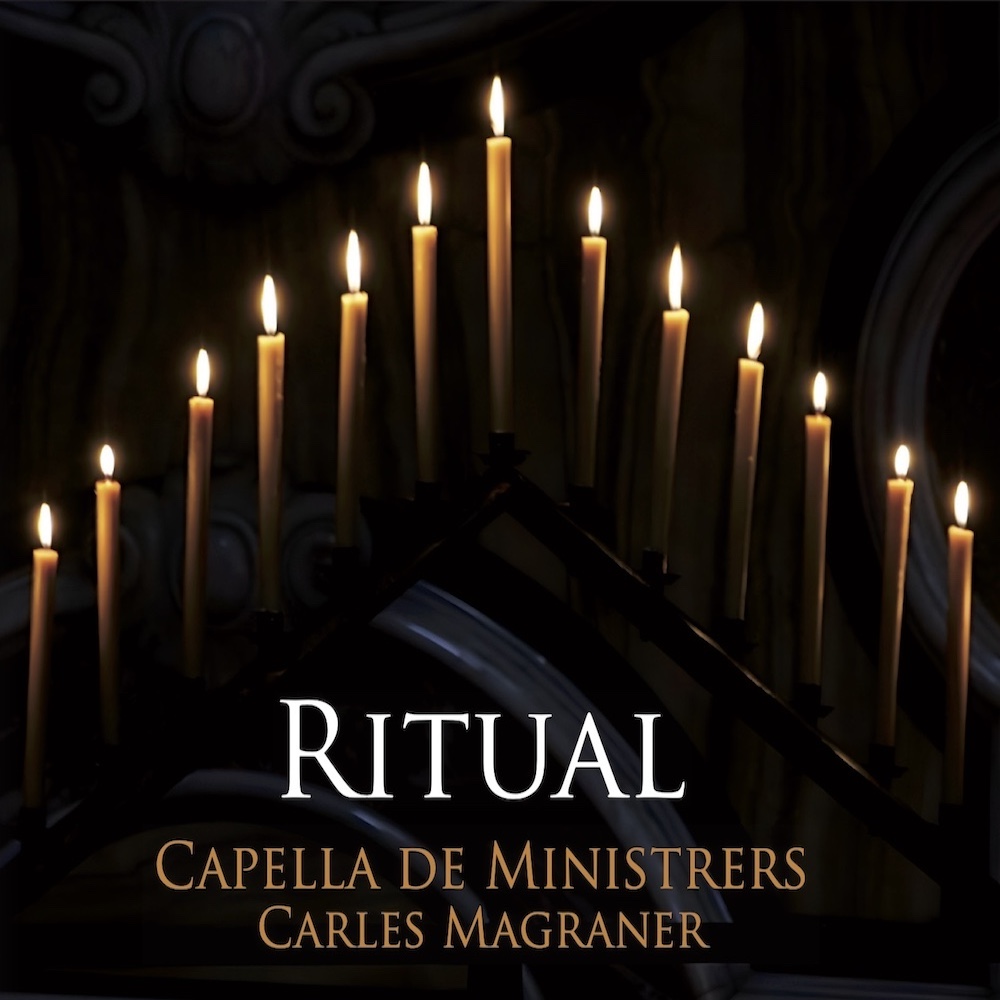
Ritual
The Cicle of Life. Sephardic and Arab-Andalusian Songs
The repertory “Ritual. Cycle of Life” by Capella de Ministrers revives the shared memory of the Mediterranean peoples through Sephardic and Arab-Andalusian chants that convey sorrow, hope, and dignity. Heir to the Sephardic exile of 1492, this music links cities from Istanbul to Jerusalem, recalling the strength of a culture built on coexistence against oppression and oblivion. It resounds as a cry against exclusion and as an act of resistance in favor of peace and against genocide.
Available from 4th November 2025
15,90 € IVA incl.
Description
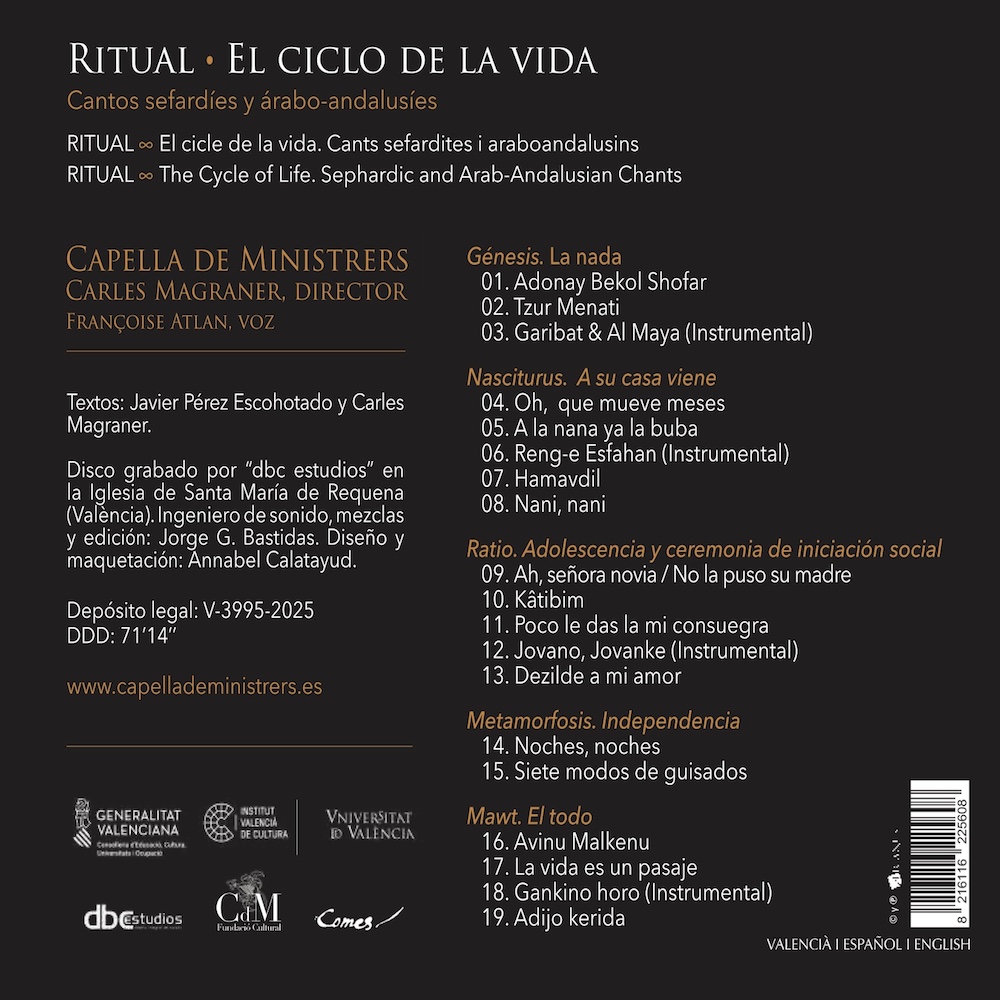
CDM 2560
Textes by Javier Pérez Escohotado and Carles Magraner
Languages: Spanish, English, Valencian
Sound engyneer: Jorge García Bastidas (dbc estudios)
Design: Annabel Calatayud
Legal deposit: V-3995-2025
CAPELLA DE MINISTRERS
CARLES MAGRANER, direcció
Françoise Atlan, voice
Carles Magraner, viols
Aziz Samsaoui, kanun, saz, oud
Kaveh Sarvarian, nay, tombak
Jota Martínez, shofar, hurdy-gurdy, kopuz, lute, darbuka, riq and tar
Genesis. Nothingness
01. Adonay Bekol Shofar
02. Tzur Menati
03. Garibat & Al Maya (Instrumental)
Nasciturus. To His Home He Comes
04. Oh, que mueve meses
05. A la nana ya la buba
06. Reng-e Esfahan (Instrumental)
07. Hamavdil
08. Nani, nani
Ratio. Adolescence and the Ceremony of Social Iniciation
09. Ah, señora novia / No la puso su madre
10. Kâtibim
11. Poco le das la mi consuegra
12. Jovano, Jovanke (Instrumental)
13. Dezilde a mi amor
Metamorphosis. Independence
14. Noches, noches
15. Siete modos de guisados
Mawt. The All
16. Avinu Malkenu
17. La vida es un pasaje
18. Gankino horo (Instrumental)
19. Adijo kerida
Javier Pérez Escohotado
In this repertory, Ritual. Cycle of Life, presented by Capella de Ministrers, both the sacred and the profane are explored, each invoked in what they share of ritual, of gesture and celebration, of remembrance, of culture, of communal worship. If History is the custodian of memory, we are the peninsula across which, for better or worse, willingly or by force, individuals of the three monotheistic faiths—Christians, Jews, and Muslims—have passed and coexisted. Into that vast repository which is History, all of them contributed memorable riches and their own distinctive culture.
That coexistence, far from idyllic as it often was, has sometimes been interpreted as a kind of golden age of concord and tolerance. Evidently, such an age existed only in part. Yet, even so, we would all wish that, after the passing of centuries, coexistence and tolerance might cease to be an unworkable utopia and become instead a viable possibility.
The Sephardim—Jews who form part of our own history, the very History of Spain—after their expulsion, exodus, and dispersion in 1492, gathered around the name Sefarad, the name they gave to Spain and, by extension, the Iberian Peninsula. From this symbolic and cultural center, shared by those faiths, they reached the most distant points—across a sea they navigated and knew well. Wherever they arrived, they brought their crafts and knowledge, preserving the living tongue of their ancestors: Sephardic, ladino, or Judeo-Spanish. They settled above all on the shores of that sea of veneration, the mare nostrum, the common sea. Hence these canticas of Ritual. Cycle of Life intermingle sounds of Hebrew, Arabic, Turkish, Bulgarian, not only Ladino or Sephardic—since in sharing a common music, one could still imagine oneself in Casablanca, Salonika, Sofia, Ferrara, Venice, Odessa, Istanbul, Tangier, Algiers, Tunis, Tripoli, Alexandria, Smyrna… and perhaps even today, still weeping in Jerusalem.
Carles Magraner
The Ritual and the Cycle of Life that shape the repertory of Capella de Ministrers transcend cultural boundaries through the profound common root of the Mediterranean peoples. For centuries this mare nostrum has been a meeting ground, a space of coexistence for Jewish, Sephardic, Arab, Turkish, Greek, and many other communities, who shared languages, customs, and music in a web of exchanges and cross-fertilizations. After the expulsion of the Sephardic Jews from Spain in 1492, their communities maintained and enriched their musical and social traditions in their new settlements around the Mediterranean basin. Out of this arose a musical culture of great richness and diversity, expressed in many tongues—Hebrew, Arabic, Turkish, Bulgarian, Ladino—emblems of coexistence and dialogue among diverse peoples.
Music is a universal language, able to convey sorrow, hope, spirituality, and the daily life of those who perform and share it. It is living testimony of collective memory and a tool of social cohesion. When we evoke places such as Casablanca, Salonika, Sofia, Ferrara, Venice, Odessa, Istanbul, Tangier, Algiers, Tunis, Tripoli, Alexandria, Smyrna, or Jerusalem, we are giving voice to a common cultural memory and celebrating the dignity and historical wealth of the peoples of the Mediterranean. This Ritual, born of crossroads and of shared histories, embodies plurality, coexistence, and the integrative force of culture, standing against oblivion, genocide, and exclusion. To honor this legacy is itself an act of historical recognition and a pledge for coexistence, peace, and dialogue among cultures.
Françoise-Flore Atlan
I had the opportunity to meet Carles Magraner in Casablanca, Morocco, just after a concert he had given with the Arab-Andalusian Orchestra in Fez. We immediately bonded over the Sephardic repertory, and shortly thereafter he invited me to collaborate. It was a true pleasure to sing surrounded by magnificent musicians, under the direction of this great artist and master—accompanied inwardly by the voices of my mother, my grandmother, and my aunts.
Moving from my lyrical voice to my more “natural” voice, and at times singing in that intermediate register for which I have such affection, I had the chance to learn enormously during this recording: a marvellous memory in an exceptional place! The ornaments, which arise so organically in the singing, are due to the excellent arrangements of Carles Magraner—faithful to tradition, yet daring at the same time: a sure way of giving life to a repertory that is multiple, commemorative, always present, and at the same time forward-looking.
powered by Advanced iFrame
Additional information
| Weight | 120 g |
|---|
Related products


- Out of Stock